
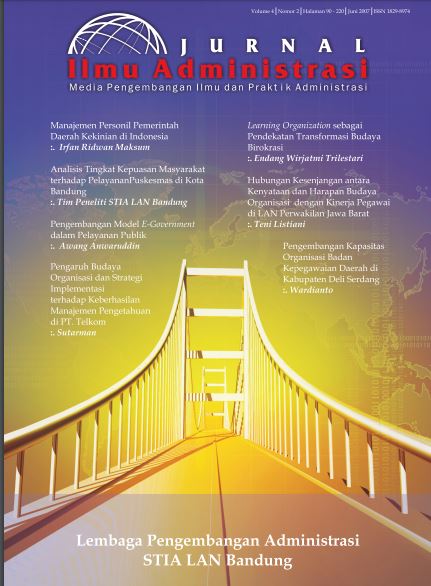
HUBUNGAN KESENJANGAN ANTARA KENYATAAN DAN HARAPAN BUDAYA ORGANISASI DENGAN KINERJA PEGAWAI DI LAN PERWAKILAN JAWA BARAT JAWA BARAT
##plugins.themes.bootstrap3.article.sidebar##
##plugins.themes.bootstrap3.article.main##
Abstract
This research aims at finding out the corelation between the gap of current practices and ideals of organizational culture and employees’s performance in institution National Institute of Public Administration West Java Regional Office. This study employs an explanatory survey method, which is commonly used to correlate and examine two variables. In this resarch an independent variable (X) is the gap between the current practices and ideals of organizational culture as
perceived by employees, whereas a dependent variable (Y) is employees’s performance. The result of hypothesis examination shows that at the level of 0.0, there is a correlation between the gap of current practices and ideals of organizational culture and employees’s performance with the degree of correlation categorized as strong (rs = -0.643) The conclusion of this study shows that employees: a) perceive the current practices of organizational culture are oreiented towards power and role culture. b) employees expect that
organizational culture should be oriented toward achievements and support culture. Another connclusion is that the correlation between current practices of organizational culture and employees’s performance is negative, and the correlation between ideals oforganizational culture and employees’s performance is negative as well.
##plugins.themes.bootstrap3.article.details##
Authors who publish with this journal agree to the following terms:
- Authors retain copyright and grant the journal right of first publication with the work simultaneously licensed under a Creative Commons Attribution-NonCommercial-ShareAlike 4.0 International License that allows others to share the work with an acknowledgment of the work's authorship and initial publication in this journal.
- The journal allow the authors to hold the copyright without restrictions and allow the authors to retain publishing rights without restrictions.
- Authors can enter into separate, additional contractual arrangements for the non-exclusive distribution of the journal's published version of the work (e.g., post it to an institutional repository or publish it in a book), with an acknowledgment of its initial publication in this journal.
- Authors are permitted and encouraged to post their work online (e.g., in institutional repositories or on their website) before and during the submission process, as it can lead to productive exchanges, as well as earlier and greater citation of published work.
References
Bernardin J & Joyce EAR. 1998. Human Resources Management: An Experiental Approach.
Singapore: McGraw-Hill.
Denison DR. 1990. Corporate Culture and Organizational Efectiveness. NewYork: John Wiley
& Sons.
Gibson, Ivancevich, Donelly. 1997. Organization – Behavior, Structure, Process. Irwin.
Haynes RJ. 1980. Organization Theory and Local Government. London: GeorgeAllen ITP
Company.
Hellriegel D, John WS Jr, Richard W.W. 1998. Organizational Behavior. ITP Company.
Kotter JP & James LH. 1997. Corporate Culture and Performance. New York: Simon &
Schuster Inc.
Kreitner, Robert, Angelo, Kinicki. 1998. Organizational Behavior. Irwin/McGraw Hill.
Luthans F. 1995. Organizational Behavior. McGraw Hill, Inc.
McShane SL, Mary VG. 2000. Organizational Behaviour. Irwin/McGraw-Hill.
Newstrom and Davis K. 1993. Organizational Behavior, Human Behavior at Work. New Jersey:
McGraw-Hill.
Prawirosentono S. 1999. Manajemen Sumber Daya Manusia – Kebijakan Kinerja Karyawan-.
Yogyakarta: BPFE.
Putti MJ. 1984. Manager’s Primer on Performance Appraisal: Concepts and Techniques.
Singapore Institute of Management, Maruzen Asia Pte Ltd.
Robbins SP. 1987. Organization Theory, Structure, design, and Applications. New Jersey:
Prenice-Hall, Inc.
Schein EH. 1997. Organizational Cultural and Leadership, 2nd ed. California: Jossey-Bass.
Singarimbun M. 1989. Metode Penelitian Survey. Yogyakarta: UGM.
Sugiyono. 2000. Metode Penelitian Administrasi. Bandung: Alfabeta.