
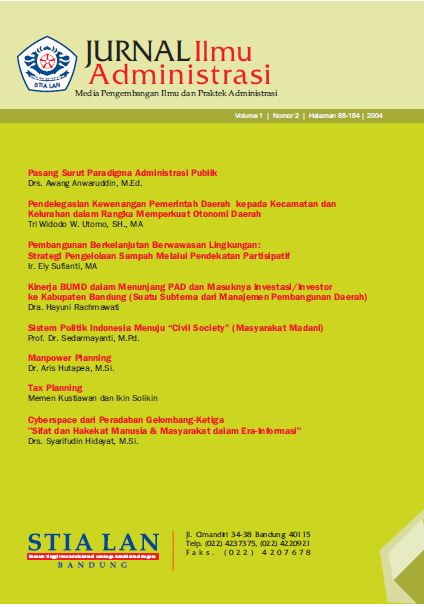
Manpower Planning
##plugins.themes.bootstrap3.article.sidebar##
##plugins.themes.bootstrap3.article.main##
Abstract
In term of human resource management, there are two dillematic problemscoming together. In one hand, in line with the progress of organization the more developing and complicated tasks and responsibilitiesof human resource, and the increasing demands on quality and quantit, cause the additional workload. On the other hand, the decreasing skills, knowledge, and motivation, which can be caused by the weakening memory, work boredom, age and other biological factors, may cause the decreasing work capacity. Undoubtedly, these two factors create a gap. Therefore, manpower planning should be carried out, covering with such strategies as empowerig thecompetent workforce , giving them opportunities to choose the appropriate jobs, helping them to optimize their energy, building self-confidence, sending them to education and training programs, stimulating their work imagination, awakening their work creativity and innovation, and implementing proper rotation and promotion.
##plugins.themes.bootstrap3.article.details##
Authors who publish with this journal agree to the following terms:
- Authors retain copyright and grant the journal right of first publication with the work simultaneously licensed under a Creative Commons Attribution-NonCommercial-ShareAlike 4.0 International License that allows others to share the work with an acknowledgment of the work's authorship and initial publication in this journal.
- The journal allow the authors to hold the copyright without restrictions and allow the authors to retain publishing rights without restrictions.
- Authors can enter into separate, additional contractual arrangements for the non-exclusive distribution of the journal's published version of the work (e.g., post it to an institutional repository or publish it in a book), with an acknowledgment of its initial publication in this journal.
- Authors are permitted and encouraged to post their work online (e.g., in institutional repositories or on their website) before and during the submission process, as it can lead to productive exchanges, as well as earlier and greater citation of published work.
References
Amstrong Michael, 1990, Manajemen Sumber daya Manusia, Alih Bahasa: Sofyan Hikmat dan Haryanto. Jakarta: PT Gramedia
Belasco James A, 1980, Teching The Elephant To Dance: The Managers Guide To Empowering Change. New York: A Plume Book
Bruce Anne, 2003, How To Motivate Every Employee, Alih Bahasa: Severinus Poso. Jakarta: PT Bhuana Ilmu Populer (BIP)
Daft Richard L, 2002, Manajemen, Alih Bahasa: Emil Salim, Tinjung Desi Nursanti, Maryanmi Hermanto. Jakarta: Penerbit Erlangga
Famularo, Joseph J., 1986, Handbook Of Human Resources Administration, New York: Mc. Grow Hill Inc.
Hasibuan, Malayu, 2000, Manajemen Sumber daya manusia, Jakarta: Bumi Aksara
Hutapea, Aris, 2003, Pemberdayaan Karyawan (Disertasi) Bandung: UNPAD
Taylor, Harold, 2002, Teknik Mendelegasikan Tugas & Wewenang, Alih Bahasa: Ny Rochmulyati Hamzah. Jakarta: Seri Manajemen SDM No 3 PPM
Sutermeister, Robert A., 1976, People and Productivity, New York: Mc Grow Hill Book Company
Mobley, William H, 1986, Pergantian Karyawan, Sebab Akibat dan Pengendaliannya, Jakarta: LPPM Seri Manajemen No 27 PPM
Nelson Bob, 2003, 1001 Cara Memberdayakan Karyawan, Jakarta: Prestasi Pustaka
Wahyudi Bambang, 1996, Manajemen Sumber daya Manusia, Bandung: Suliuta
Wursanto, IB, 1989, Manajemen kepegawaian, Jakarta: Kanisius